
Only around 40% of higher educational institutions offering media degrees have formal partnerships with media houses.
Report examines the state of media education in Pakistan and charts a path for modernisation.
Stronger partnerships between educational institutions, media houses and professional journalism associations are required to update media education in the country, according to a landmark new research report.
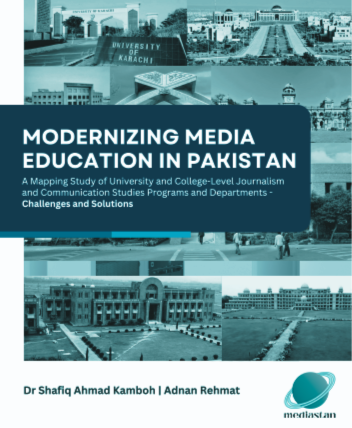
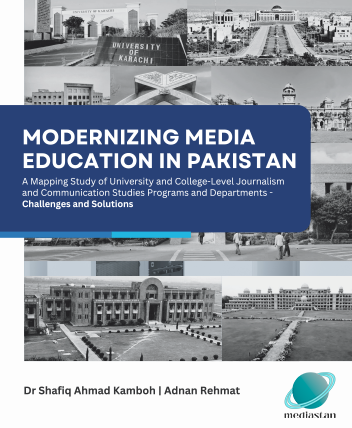
The report titled “Modernizing Media Education in Pakistan,” produced by International Media Support, Mediastan and the Institute for Research, Advocacy and Development (IRADA), reviews the higher education landscape of journalism and communication studies in Pakistan. The report is based on a survey of faculty at 92 Pakistani universities and colleges that offer bachelor’s degree programmes in media and communication studies.
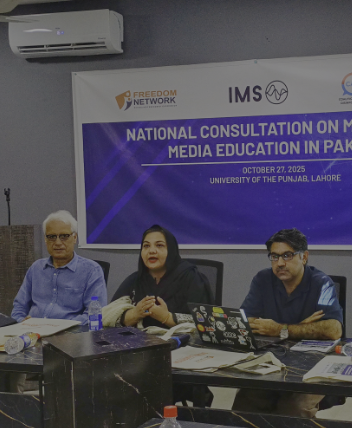
The study was launched at a national conference of education departments hosted by the Department of Digital Media of the Punjab University in Lahore in collaboration with IMS and Freedom Network. Dr Savera Shami of the Department hosted the meeting.
The study’s findings suggest that major strides have been made in media education. The number of universities with degree-awarding media and communication studies departments has more than tripled from just 21 in 2006 to 100 in 2025 reflecting a burgeoning need to service public interest journalism in Pakistan.
All the 92 surveyed universities offer bachelor’s degrees in media while over half of them also offer master’s programmes and one-third offer PhD education in media studies. These media programmes have 37,500 students enrolled altogether nationwide currently.
The report also highlights challenges and gaps in the current media education ecosystem. While many departments offer updated courses addressing contemporary media challenges, such as countering disinformation, they also struggle with uneven development, infrastructure and resources. Around 40% of the media departments do not have digital media labs and 10% lack all practical media facilities such as TV studios.
Nearly all departments actively facilitate internships for students, but only 41% have formal partnerships with media houses, and only around one in 10 departments have linkages with professional associations of journalists.
IMS Programme Manager Adnan Rehmat, who co-authored the report, noted the pressing need to bridge academia-industry gaps to keep both public interest journalism alive in the backdrop of a media landscape being transformed by technology and changing information ecosystem, and media education in Pakistan relevant to the needs of the professional media sector.
“Structured institutional partnerships of media studies departments with professional media associations can ensure students are exposed to professional journalism ethics, media and labour laws, newsroom cultures and policy debates,” Rehmat said. “Collaborations of departments must also expand beyond traditional news outlets to digital-first and non-legacy media.”
The report offers a 16-point roadmap to modernise media higher education in Pakistan through structural reforms, public–private collaboration, industry-aligned curriculum updates, faculty development, regional coverage and regional and gender inclusivity. It also calls for stronger ties among media studies departments, with media houses and professional bodies to boost experiential learning and career opportunities for graduates.
The report specifically recommends that media departments should collaborate with private, regional and community news outlets for student internship placement, newsroom simulation, co-designed projects and skills workshops to introduce media students to industry trends related to AI, multimedia production and digital innovation.
Furthermore, the report encourages investments to establish comprehensive training facilities on campus, including digital media labs, diversify academic specialisations informed by market needs and expand faculty exchange programmes to train professors in line with global standards.
University of the Punjab Assistant Professor Dr Shafiq Ahmad Kamboh, who co-authored the study, said the report’s findings stress the importance of media education reforms.
“The rapid growth of media education shows that there is a demand for professionally trained graduates,” Kamboh said. “Investment in faculty capacity, accreditation mechanisms, and pedagogical innovation will sustain quality while keeping pace with growth and technological change.”
The research also found that over half of the media departments (54%) are located in Punjab, indicating a geographical disparity. Two-thirds of the media studies departments operate at public-sector universities. While no private sector universities offering media education were identified in Balochistan, Azad Jammu & Kashmir, or Gilgit-Baltistan, public sector universities and colleges maintain media departments in every administrative unit of the country, indicating a broader institutional recognition of the importance of media education.
The report is available for download in the Mediastan publications section here.