
In a landmark move to strengthen science communication and journalism in Pakistan, a group of leading stakeholders has announced the establishment of the Pakistan Network for Science Communication (PNSC).
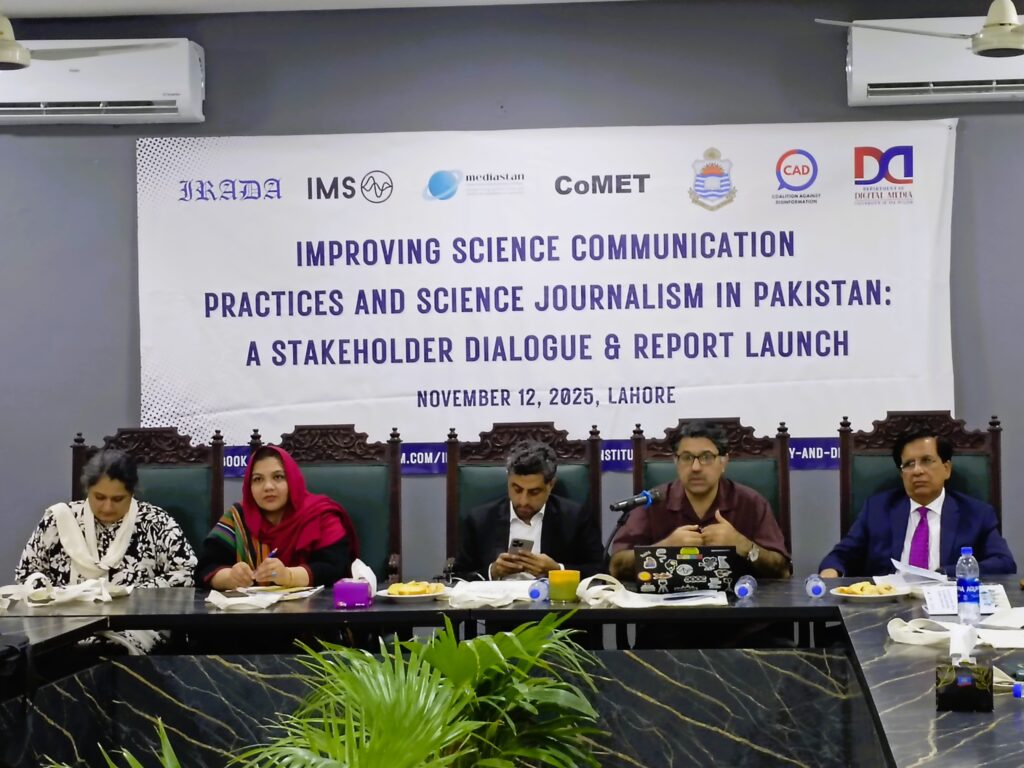
This initiative was formalised during a national consultation at the Department of Digital Media, University of the Punjab, following the launch of the report, “Information Integrity, Rationalist Media and Public Interest Discourse: Mapping and Analysing Science Communication and Science Journalism Practices in Pakistan.”
The report, co-authored by Dr Shafiq Ahmed Kamboh and Adnan Rehmat, was produced through technical facilitation of the International Media Support (IMS) by its partner Institute for Research, Advocacy and Development (IRADA).
The study underscores the urgent need to strengthen science communication in Pakistan to bridge the gap between scientific research and public discourse. It says effective science communication is essential for fostering scientific literacy, supporting evidence-based policymaking, and inspiring the next generation of scientists and critical thinkers. It stresses that without prioritised reforms, Pakistan risks missing opportunities to leverage its growing scientific output for national development.
The announcement said that acting on the recommendations of the report, the PNSC will bring together science organisations, academia, media, policymakers, and civil society to address systemic weaknesses in science communication and journalism.
It said the Network will aim to: Unite diverse actors to collaboratively address challenges in science communication; Institutionalize science communication as a professional and strategic priority, improving both the quantity and quality of science content; Build resilience against misinformation by enhancing information integrity and supporting capacity building for content creators and public relations professionals; Empower journalists and content creators with access to scientific expertise and locally relevant stories; Promote evidence-based policymaking and foster a culture of scientific literacy to support national development; and Ensure long-term sustainability through international partnerships and science-centric initiatives.
The PNSC digital secretariat will be managed by Mediastan, to support stakeholder outreach, research, advocacy and training in science communications and journalism. The initiative is steered and facilitated by IMS.
“Science communication in Pakistan remains largely ceremonial. Unless universities and science organizations start translating their research into accessible public knowledge, our science will stay confined to laboratories and libraries instead of shaping public awareness and policies,” Dr. Shafiq Ahmed Kamboh, the co-author of the report said.
“When scientists, communicators and journalists work together, evidence guides informed public debate. Strengthening this interface is vital for countering misinformation, strengthening information integrity and promoting rational public interest journalism,” Adnan Rehmat, co-author of the report said.
“A Network like this will help improve awareness about native science scholarship and the work of science national establishments that often go unhighlighted in media,” Dr. Savera Shami, head of the Digital media Department said.
Muhammad Aftab Alam, Executive Director of IRADA, stated this groundbreaking research is a manifestation of our commitment to research on such areas. Therefore, we are pleased to launch this report today with the desire to open research-based discourse on science communication in Pakistan.
Stakeholders agreed that in the context of Pakistan’s growing science community and the increasing importance of technology and digitalization, coordinated, multi-sectoral action is essential. Without such collaboration, science communication risks remaining fragmented and ineffective. The PNSC is positioned as a strategic solution to bridge gaps, promote collaboration, and ensure that science communication and journalism serve the public interest, strengthen society, and drive national progress.