
Coalition of Media Education and Teaching (CoMET)
CoMET is a pioneering alliance of university and college-level media studies departments from across Pakistan, established in October 2025 in Lahore.
Born out of a national consultation on “Modernizing Media Education in Pakistan” under the International Media Support (IMS) Pakistan programme, CoMET brings together academic institutions committed to advancing excellence, innovation and integrity in media education. It includes over 30 media studies departments as founding members and aims to include all the 100+ such educational institutions offering undergraduate or post graduate academic degrees in media studies in Pakistan within its fold.
CoMET’s mission is to unite the country’s media education community to collaboratively address the challenges and opportunities presented by Pakistan’s rapidly evolving, tech-driven media landscape. Recognising the urgent need for modernisation, CoMET aims to foster academic excellence by promoting up-to-date curricula, innovative teaching methods and robust assessment standards. The coalition is dedicated to strengthening collaboration among educators, researchers and practitioners, to sharing resources and expertise and to advancing media literacy and critical thinking among students.
Key objectives of CoMET include supporting professional development for faculty, advocating for academic freedom and ethical standards and mobilising resources through partnerships at national and international levels. The coalition is committed to developing model curricula, organising conferences and workshops, facilitating collaborative research and launching faculty development programmes tailored to the needs of Pakistan’s media environment.
CoMET operates through a voluntary, representative steering committee and is supported by a digital secretariat facilitated by Mediastan, the IMS Pakistan programme portal. Membership is open to all university and college-level media departments, as well as individual educators and professionals dedicated to the advancement of media education in Pakistan. Through regular meetings, working groups and partnerships with industry and civil society, CoMET strives to ensure that media education in Pakistan remains relevant, progressive and impactful in the digital age.
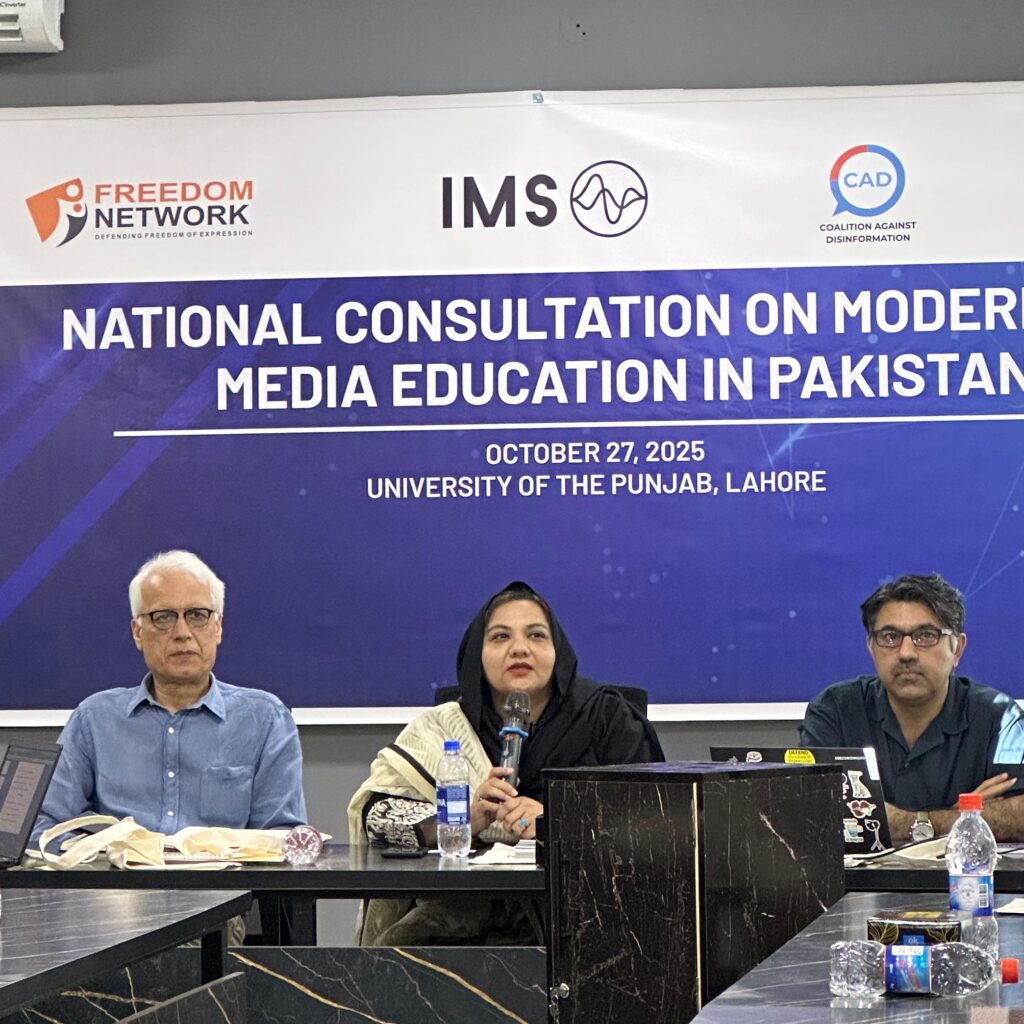
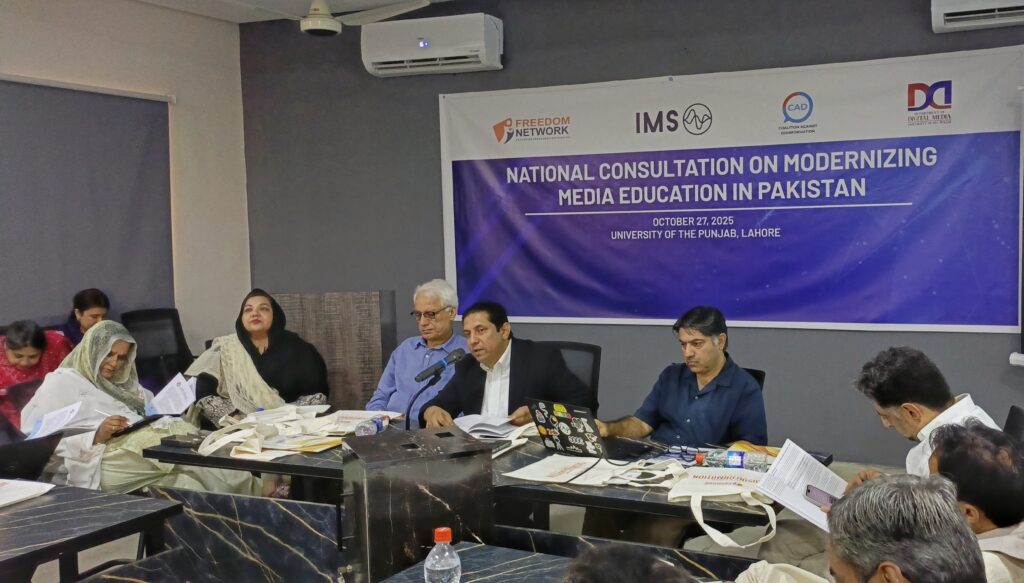
A group of 34 media studies departments of universities and colleges teaching journalism, mass communication and communication studies from across Pakistan, meeting at a consultation dialogue under the aegis of an International Media Support (IMS) Pakistan programme on ‘Modernizing Media Education in Pakistan’ at the Department of Digital Media of the University of The Punjab in Lahore on October 27, 2025, as an outcome of the consultation, unanimously agreed to establish the Coalition of Media Education and Teaching (CoMET) with the following goals, objectives, plans and operational framework:
Goal
The Coalition on Media Education and Teaching (CoMET) will unite university and college-level media departments across Pakistan to collaboratively advance excellence, innovation, relevance and integrity in media education and teaching.
Rationale
Like elsewhere, Pakistan’s media and journalism landscape is undergoing rapid tech-driven and digital transformation, necessitating university and college level media studies departments to modernise in tandem to remain relevant and sustainable.
As the findings and recommendations of the “Modernising Media Education in Pakistan” 2025 report produced under the International Media Support (IMS) Pakistan programme indicate, this would require a holistic modernisation framework including structural reforms, curricula development and capacity and resource mobilisation.
Considering that Pakistan in 2025 had around 100 higher education departments teaching media studies, an organised coalition can address these challenges by encouraging collaboration, sharing best practices, mobilising resources and advocating for progressive reforms in media education.
CoMET Objectives
CoMET will:
1. Strengthen the collective voice and visibility of the media education community of Pakistan.
2. Promote academic excellence by encouraging the adoption of up-to-date curricula, teaching methods and assessment standards across member institutions.
3. Strengthen collaboration among media educators, researchers and practitioners to share resources, expertise and research findings.
4. Advance media literacy and critical thinking skills among students to prepare them for the challenges of the digital information age.
5. Support professional development for faculty through training, workshops and exchange programmes.
6. Advocate for academic freedom, ethical standards and inclusivity in media education.
7. Mobilise technical and financial resources through individual, bilateral and multilateral initiatives via national and international partnerships with media and academia development actors.
Potential initiatives
CoMET aims to:
1. Develop and disseminate model curricula and teaching resources tailored to Pakistan’s media environment.
2. Organise national conferences, seminars and workshops on emerging trends in media, journalism, and communication studies.
3. Facilitate collaborative research projects among member institutions on media education, digital literacy and related topics.
4. Launch faculty development programmes including training on digital pedagogy, research methods and industry engagement.
5. Create a digital platform for resource sharing, networking and ongoing dialogue among educators and students.
6. Engage with industry partners to align academic programmes with market needs and facilitate student internships and placements.
Operational framework
- Platform: International Media Support (IMS) Pakistan portal Mediastan will facilitate a digital secretariat for CoMET to coordinate its activities, convene regular meetings, and manage communications among members.
- Membership: All media studies departments at the founding consultation dialogue became ‘Founding Members’ of CoMET. Further membership will be open to all university and college-level media departments, as well as relevant individual educators, researchers, and professionals committed to advancing media education in Pakistan. Membership will be voluntary and non-fee based. CoMET will, on priority on behalf of the Founding Members, invite all remaining media studies departments, both at the university and college levels, to become members of CoMET to enhance solidarity, voice and visibility of the Coalition and all its members.
- Governance: Facilitated by IMS, CoMET will operate through a voluntary steering committee elected from among its members, ensuring representation from diverse regions and institution types.
- Activities: Regular meetings (virtual or in-person) at the national and regional levels will be held to review progress, plan initiatives, and address emerging challenges. Working groups may be formed for specific projects or thematic areas.
- Collaboration: CoMET will encourage partnerships with media organizations, regulatory bodies, and civil society and international supporters to enhance the impact of its mandate and initiatives. Member institutions will be able to directly enter into independent or collaborative agreements to pursue institutional priorities as well as promoting the goals and objectives of CoMET.
Members
The following media studies departments have joined the coalition through their respective representatives (in alphabetical order by name of parent university).
- Bahauddin Zakariya University, Institute of Media and Communication Studies, Prof. Dr. Shahzad Ali
- Bahria University, Department of Media Studies, Dr. Abid Ali Butt
- Beaconhouse National University, School of Media and Mass Communication, Prof. Dr. Bushra Hameed ur Rahman
- Fatima Jinnah Women University, Department of Communication and Media Studies, Dr. Saadia Ishtiaq Nauman
- Forman Christian College (FCCU), Department of Mass Communication, Dr. Firasat Jabeen / Dr. Syed Muhammad Saqib Saleem
- GC University Lahore, Department of Media and Communication Studies, Dr. Mukhtar Ahmad
- GIFT University, Department of Mass Communication & Media Studies, Dr. Mohsin Ali Shams
- Government College University Faisalabad, Department of Mass Communication, Dr. Salma Umber
- Government Dyal Singh Graduate College, Department of Mass Communication, Dr. Ammara Iqbal
- Government Fatima Jinnah Graduate College for Women-Chuna Mandi, Mass Comnmunication Department, Ghazala Kanwal
- Government Graduate College for Women-Township, Department of Mass Communication, Ume Kalsoom Rashida
- Government Graduate College Gulberg, Department of Mass Communication, Dr. Waseem Ghafoor / Muhammad Junaid
- Government MAO Graduate College, Department of Communication Studies, Asim Hafeez
- Government Queen Mary Graduate College, Department of Mass Communication, Dr. Saima Iqbal
- International Media Support, Pakistan, Adnan Rehmat
- Islamic International University Islamabad, Department of Media & Communication Studies, Dr. Naila Rafique
- Kinnaird College for Women, Department of Media Studies, Dr. Kiran Karamat
- Kohat University of Science and Technology, Department of Media and Communication Studies, Dr. Rahman Ullah
- Kohsar University Murree, Department of Mass Communication & Media Studies, Dr. Irfan Qadir
- Lahore College for Women University, Department of Mass Communication, Dr. Arsha Saleem Meer
- Lahore Garrison University, Department of Media & Communication Studies, Dr. Ifra Iftikhar
- Lahore Leads University, Department of Mass Communication, Dr. Imran Saleem
- Mediastan, Waqas Naeem
- National University of Modern Languages (NUML) Islamabad campus, Department of Media and Communication Studies, Dr. Ayesha Siddiqua
- National University of Modern Languages (NUML) Lahore campus, Department of Media and Communication Studies, Dr. Maham Zahid
- National University of Modern Languages (NUML) Rawalpindi campus, Department of Media & Communication Studies, Naheem Gul
- Rashid Latif Khan University, Department of Media and Communication Studies, Shabbir Hussain Sadiq
- Riphah International University, Riphah Institute of Media Sciences, Dr. Muhammad Riaz
- Sardar Bahadur Khan Women’s University, Department of Media and Journalism, Spozmei Shah
- Superior University, Faculty of Social Sciences, Dr. Nasir Khan
- The University of Azad Jammu & Kashmir, Department of Mass Communication, Dr. Saima Quddoos
- University of Central Punjab, Department of Media and Communication Studies, Dr. Hina Adeeb
- University of Home Economics, Department of Media and Communication Studies, Dr. Pawan Masaud
- University of Lahore (UOL), School of Creative Arts, Dr. Abul Hassan
- University of Management & Technology, School of Media & Communication Studies, Dr. Mian Jawed
- University of Sargodha, Department of Communication and Media Studies, Dr. Mudassar Hussain Shah
- University of the Punjab, Department of Communication and Media Research, Dr. Noshina Saleem
- University of the Punjab, Department of Digital Media, Prof. Dr. Savera Mujeeb Shami
- University of the Punjab, Department of Journalism, Dr. Naveed Iqbal Chaudhry
- University of the Punjab, Department of Media and Development Communication, Dr. Ayesha Ashfaq
- University of the Punjab, Department of Public Relations and Advertising, Dr. Faiza Latif
- Virtual University of Pakistan, Department of Mass Communication, Dr. Nadia Saleem